That’s the reality of API commerce today: a network of systems exchanging data and events—often in real time—under constant business change.
But there’s a consistent failure mode: integrations become the bottleneck. A promo launch breaks checkout. A catalog re-model forces downstream rewrites. A PIM export adds a new attribute and suddenly the storefront can’t render variants correctly. Teams lose time chasing “who changed what” across services.
This is integration churn—recurring rework caused by unclear, unstable, or weakly enforced contracts between systems. It’s not just an engineering tax; it delays launches, creates brittle dependencies, and erodes confidence in the platform.
A structured commerce API and a contract-first mindset are the cleanest way out. This is where Commerce Engine shines: by treating API contracts as first-class product artifacts—designed, versioned, and validated—Commerce Engine makes integrations predictable, safer to evolve, and dramatically easier to operate over time. In short: API-first commerce works best when contracts are explicit and enforced.
This article explains what “structured” and “contract-first” actually mean in practical terms, why they reduce integration churn, and how to implement the patterns in a real Commerce Engine–style architecture.
The root cause of integration churn in API commerce
Most integration churn comes from three systemic issues:
1) Ambiguous data models
When payloads are loosely defined (“flexible JSON”), teams fill gaps with assumptions. One system sends price: "19.99", another expects price: 19.99. One integration treats inventory as “available-to-sell”, another treats it as “on-hand”. Those mismatches don’t show up until production.
2) Implicit coupling
A storefront starts depending on a field that “happens to exist.” A promotion service starts reading cart internals. Suddenly, changes in one area cascade into outages elsewhere. This is the opposite of composability.
3) Weak change management
Without clear versioning and compatibility rules, every change is a breaking change in disguise. Teams respond by freezing schema evolution (slowing business), or by shipping “temporary” workarounds that become permanent.
A contract-first approach addresses all three: it makes the model explicit, reduces implicit coupling, and turns change into a controlled process instead of an incident.
What is a structured commerce API?
A structured commerce API is not “more endpoints” or “more documents.” It’s an API where:
Core commerce concepts are modeled as well-defined resources (Product, Variant, Price, Inventory, Cart, Order, Payment Intent, Return, etc.).
Each resource has a stable schema with explicit types, constraints, and semantics.
Extensibility exists, but is bounded (e.g., typed attributes, namespaced metadata, well-defined extension points).
State transitions are modeled explicitly (e.g., order state machine) instead of ad-hoc status strings.
Events mirror those structures, with versioned event payloads.
This structure is what enables a type-safe e-commerce API experience: the API surface is predictable enough that tools (OpenAPI, GraphQL schemas, SDK generators, runtime validators) can enforce correctness.
In practice, structured beats “flexible” because commerce isn’t a free-form domain. It has invariants:
A cart line item must reconcile to pricing rules.
Inventory must never go negative in reservation flows.
Payment capture must match the authorized amount and currency.
Taxes depend on ship-to, ship-from, nexus rules, and item tax codes.
You can represent these rules in unstructured JSON, but you’ll pay for it in endless edge cases. Structured models encode correctness up front.
What does “contract-first” mean in Commerce Engine terms?
Contract-first means the API contract is designed and governed before implementation details spread across teams and partners.
In a contract-first Commerce Engine approach:
Schemas are the source of truth
OpenAPI/JSON Schema or GraphQL SDL define resources, fields, enums, and constraints.
Compatibility rules are explicit
What is considered breaking vs non-breaking is documented and enforced.
Validation happens at boundaries
Requests and responses are validated (at least in integration tests; ideally at runtime for external callers).
SDKs and documentation derive from contracts
Types and client code are generated so consumers don’t guess.
This approach reduces integration churn because it replaces informal assumptions with enforceable agreements.
Why contracts reduce churn: the four failure modes they eliminate
1) “Unknown payload” failures
With a contract-first setup, payloads are validated and typed. If a partner sends an invalid field type or misses a required property, you catch it immediately—ideally before it reaches downstream systems.
Result: fewer production bugs caused by malformed data.
2) Silent semantic drift
The worst integration issues aren’t hard failures—they’re silent ones. Example: “inventory” starts meaning “available-to-sell” in one service and “on-hand” in another. Orders still place, but cancellations spike due to unfulfillable items.
With structured contracts, you name and model semantics explicitly:
onHandQuantity
reservedQuantity
availableToSell
allocationStrategy
Result: fewer “it looked right but wasn’t” incidents.
3) Breaking changes disguised as minor refactors
A contract-first pipeline forces you to categorize changes:
Adding an optional field: non-breaking
Renaming a field: breaking
Tightening a constraint: potentially breaking
Changing an enum meaning: breaking even if shape is identical
Result: safer evolution without freezing the platform.
4) One-off integrations that become permanent debt
When contracts are vague, every integration becomes a snowflake. Contract-first encourages standardized patterns:
consistent pagination
consistent error formats
consistent idempotency
consistent event envelopes
Result: lower total cost of ownership and faster onboarding of new channels.
Commerce Engine in an API-first commerce architecture
A practical way to position Commerce Engine in API-first commerce is to treat it as the “commerce domain core” that exposes:
Structured catalog + pricing APIs
Inventory and reservation APIs (or inventory as an integrated domain with clear semantics)
Cart/checkout APIs with typed adjustments/promotions
Order lifecycle APIs (including returns/refunds)
Events/webhooks for downstream processing
Then you compose best-of-breed services around it:
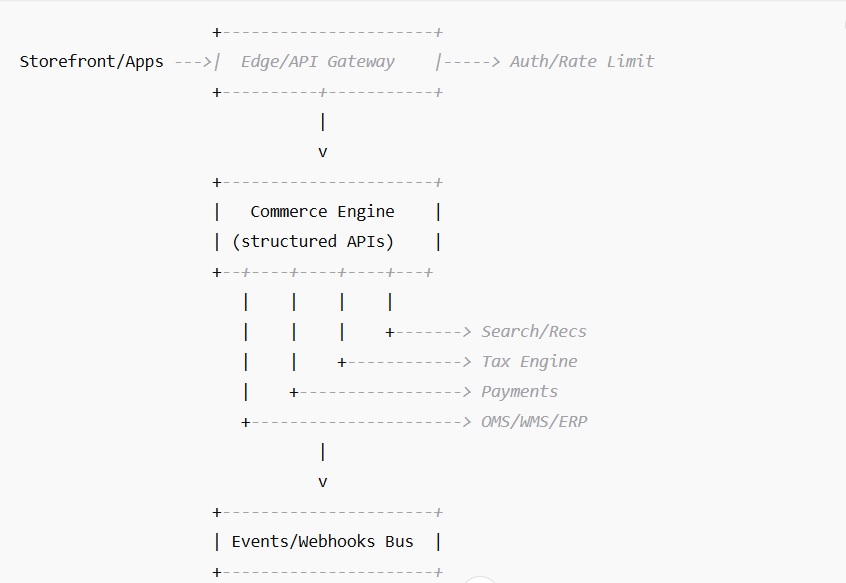
This is classic API commerce: a modular system where you can upgrade parts independently. But it only works at scale when the core contracts stay stable and evolution is managed.
The contract-first toolbox: what to standardize
If you want “Commerce Engine–grade” integration stability, standardize these contract surfaces.
1) Resource schemas (OpenAPI/GraphQL + JSON Schema)
Define each domain object with clear types and constraints.
Example patterns:
Use ISO currency codes (currency: "USD")
Use integer cents for money to avoid float issues (amount: 1999)
Use RFC 3339 timestamps (createdAt)
Use explicit IDs (productId, variantId) rather than overloaded id
2) Error contracts
A stable error format prevents every client from inventing its own parsing logic.
Recommended structure:
code (machine-readable)
message (human-readable)
details (field-level validation errors)
correlationId (for tracing)
3) Idempotency
Checkout and payment flows must be idempotent. Define:
Idempotency-Key header semantics
retention window
behavior on replays (same response vs conflict)
4) Versioning strategy
Do not rely on “we’ll be careful.” Encode it:
URL versioning (/v1/...) or header-based versioning
event versioning (order.created.v1)
deprecation timelines and migration guides
5) Event envelopes
A clean event envelope avoids chaos later. Include:
eventId
eventType
eventVersion
occurredAt
data (typed payload)
trace (correlation)
These patterns are how a structured commerce API stays usable across years of change.
Concrete example: why structured carts reduce churn
Carts are a churn magnet because they combine:
pricing
promotions
tax estimation
shipping selection
inventory checks
customer context (B2C/B2B)
multiple channels
In an unstructured approach, teams often shove data into cart line items as arbitrary JSON, and every consumer interprets it differently.
A structured, contract-first cart model instead makes the cart a ledger:
Line items (what’s being purchased)
Adjustments (discounts, fees, credits) as typed entries
Totals derived from those entries
Provenance fields to explain “why this price”
When promotions change, the contract doesn’t: you add a new adjustment type, or extend the rules engine behind the same schema. Downstream systems keep working because they depend on stable structures, not on promo rule internals.
That is the essence of Commerce Engine’s value: stable commerce primitives that evolve without breaking integrations.
Type-safe e-commerce API: how typing turns churn into compile errors
“Type-safe” isn’t a buzzword if you’ve lived through black-box payload failures.
A type-safe e-commerce API approach means:
Request/response types are generated from the contract.
Client code fails at compile time when you use the API incorrectly.
Runtime validation rejects invalid payloads at the boundary.
What this looks like for teams
Frontend engineers autocomplete correct fields instead of guessing.
Integration partners use an SDK that prevents malformed requests.
Backend teams evolve APIs with compatibility checks in CI.
Why it matters for API-first commerce
In API-first commerce, the number of clients grows:
web storefront
mobile app
POS
marketplace seller portal
customer service tooling
partner integrations
The only scalable way to keep them aligned is typed contracts.
Integration patterns that Commerce Engine makes safer
Here are the integration areas where contract-first structure pays off the most.
1) ERP integration (orders, invoices, refunds)
ERP systems are rigid. If your commerce data is unstructured, you’ll write endless mapping code.
With structured order contracts:
line items map consistently
taxes and discounts are explicit adjustments
refunds reference original captures/settlements
Churn reduction: fewer “special cases” for finance reconciliation.
2) PIM integration (catalog and enrichment)
PIM data is often messy and changes frequently.
A structured product model with:
typed attributes
variant constraints
validated option sets
…prevents malformed catalog pushes from reaching shoppers.
Churn reduction: fewer storefront rendering bugs and fewer “hotfix imports.”
3) WMS/3PL integration (inventory + fulfillment)
Without explicit inventory semantics, fulfillment is chaos.
A structured inventory contract (and/or reservation model) ensures:
checkout sees the right availability signal
reservations can be released on timeout/cancel
allocations are reconciled on fulfillment events
Churn reduction: fewer oversell incidents and fewer operational fire drills.
4) Payments + tax providers (orchestration)
Payment intents, captures, refunds, and tax estimates must be consistent in amount and currency.
Structured money + explicit state transitions enable:
idempotent retries
clean reconciliation
safe provider swaps
Churn reduction: fewer checkout incidents and easier provider migrations.
Operationalizing contract-first: a practical implementation checklist
You don’t get churn reduction by “having an OpenAPI file somewhere.” You get it by turning contracts into a workflow.
CI/CD guardrails
Lint OpenAPI/GraphQL schemas
Run breaking-change detection (compare current vs previous)
Generate SDKs on release
Run contract tests against staging
Validate example payloads in tests
Runtime guardrails
Validate inbound requests (especially partner calls)
Validate outbound webhook payloads against schemas
Enforce idempotency on write endpoints
Emit correlation IDs and structured logs
Governance guardrails
Define what “breaking” means
Publish deprecation windows
Maintain migration guides
Version event types explicitly
This is how Commerce Engine–style API commerce stays stable as the business evolves.
Measuring success: how to prove churn dropped
If you want to demonstrate that structured, contract-first APIs improved outcomes, track:
Integration change failure rate: % of releases causing integration incidents
Mean time to recovery (MTTR): faster debugging with correlation IDs + stable contracts
Partner onboarding time: days from “we got credentials” to “we placed first order”
Schema change frequency vs incidents: changes should no longer correlate with outages
Checkout conversion stability: fewer drop-offs after promos/catalog updates
A good API-first commerce platform isn’t just flexible; it’s predictable under change.
Putting it all together: why Commerce Engine wins here
Commerce Engine is most helpful when you’re scaling a composable stack and want to stop paying the integration tax repeatedly.
A structured commerce API approach gives you:
consistent primitives (catalog, pricing, inventory, cart, orders)
bounded extensibility (custom data without breaking semantics)
explicit state and adjustments (auditability and stability)
A contract-first approach gives you:
safe evolution (versioning + compatibility discipline)
faster development (typed SDKs and code generation)
fewer production surprises (validation and standardized errors/events)
In the world of API commerce, where every new channel and integration increases the surface area, the strongest competitive advantage isn’t “more features.” It’s the ability to change quickly without breaking things. That’s what structured, contract-first API-first commerce enables—and it’s why Commerce Engine is a pragmatic foundation for modern commerce stacks.
Blog FAQ:
1) What is a structured commerce API?
A structured commerce API is an API where core commerce objects (products, variants, prices, inventory, carts, orders) have explicit, consistent schemas with clear types, constraints, and semantics. Instead of “flexible JSON that everyone interprets differently,” it provides predictable resources (and extension points) so every client and integration can rely on the same contract—reducing breakage when the business evolves.
2) What does “contract-first” mean in API-first commerce?
In API-first commerce, “contract-first” means the API schema is the source of truth—designed, versioned, and validated before (and alongside) implementation. Teams generate docs/SDKs from the contract, enforce compatibility rules in CI, and validate payloads at system boundaries. This prevents silent drift and turns many integration bugs into early, actionable errors.
3) How does Commerce Engine reduce integration churn specifically?
Commerce Engine reduces churn by emphasizing stable commerce primitives (catalog, pricing, cart, checkout, orders) and by treating changes as managed contract evolution (versioning, deprecations, compatibility). Integrations stop depending on internal quirks and instead depend on durable schemas—so adding a new promo type or product attribute doesn’t force downstream rewrites.
4) What’s the difference between “type-safe e-commerce API” and “structured commerce API”?
A structured commerce API describes the shape and semantics of the domain (clean models and constraints). A type-safe e-commerce API describes the developer experience and correctness guarantees (generated types/SDKs, compile-time checks, runtime validation). Structure enables type safety; type safety makes structure practical and scalable across many clients in API commerce.
5) How do structured contracts help with promotions and pricing changes?
Promotions and pricing cause churn when discounts are “baked into” line item prices with no explanation. A structured approach models adjustments explicitly (discounts, fees, credits) and keeps totals derived from those adjustments. This means you can change promo logic behind the scenes without breaking consuming systems—because the contract for “what happened to the price” stays stable and auditable.
6) What are the must-have contract features for reliable API commerce integrations?
At minimum, you want:
· Versioning (API + event versions) with clear breaking-change rules
· Idempotency for cart mutations, checkout, and payments
· Standard error format (codes, field errors, correlation IDs)
· Consistent pagination/filtering patterns
· Event/webhook envelopes (eventId, type, version, occurredAt, data)
These features dramatically reduce operational toil and make integrations resilient to retries, partial failures, and change.
7) How can teams adopt this approach without a big-bang rewrite?
Start incrementally:
1. Pick 1–2 high-churn areas (often cart/checkout or catalog)
2. Define/clean the contract (OpenAPI/GraphQL + JSON Schema)
3. Generate a typed SDK and migrate one consumer first
4. Add contract tests + breaking-change checks in CI
5. Roll out versioned events/webhooks and deprecate old shapes gradually
This delivers quick wins while keeping delivery velocity—one of the core benefits of API-first commerce with Commerce Engine.